

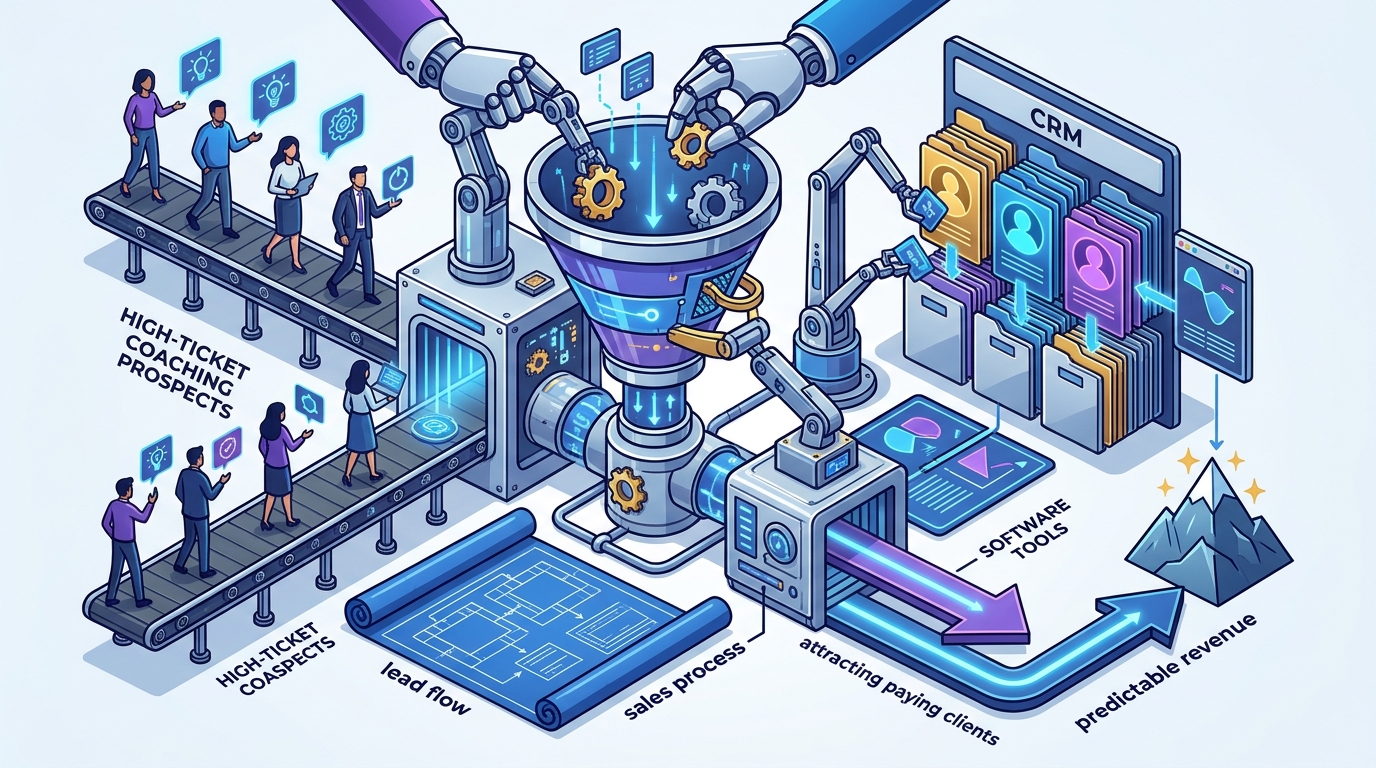
Virtual Income School helps coaches build a sales funnel and CRM by providing the systems, strategy, and hands-on support needed to attract paying clients. This guide covers the specific roles involved in funnel construction, the technical requirements for CRM integration, and the software tools that power modern coaching businesses. We will break down how to structure your lead flow and sales process to create predictable revenue.
Funnel Builder Roles
Building a high-converting sales funnel requires more than just dragging and dropping pages. It requires a strategic approach to client acquisition and sales psychology. At Virtual Income School, we emphasize that most coaches do not need more information; they need the right business built around their expertise. This involves a clear offer, content that speaks to the right buyer, and a structured lead flow system.
The Strategic Architect
The primary role in funnel construction is the strategic architect. This person defines the customer journey from first touch to final sale. They determine the value proposition and ensure that every step of the funnel aligns with the coach's brand and target audience. Without this strategic foundation, even the most technically sound funnel will fail to convert.
The Technical Implementer
The technical implementer handles the backend setup. This includes configuring the funnel software, setting up email automation, and ensuring that all tracking pixels and analytics are correctly installed. This role requires proficiency in the specific tools chosen for the business. They ensure that the funnel functions seamlessly across all devices and browsers.
The Content Specialist
Content is the fuel for any sales funnel. A content specialist writes the copy for landing pages, email sequences, and sales calls. They understand the pain points of the ideal client and craft messages that resonate deeply. Effective copywriting bridges the gap between a prospect's current state and the transformation the coach offers.
| Role | Primary Responsibility | Key Skills |
|---|---|---|
| Strategic Architect | Defining the customer journey and offer | Business strategy, market research |
| Technical Implementer | Setting up software and automation | Funnel builders, CRM configuration |
| Content Specialist | Writing persuasive copy and scripts | Copywriting, sales psychology |
CRM Integration
A Customer Relationship Management (CRM) system is the central hub of a coaching business. It is the database that stores all client interactions, leads, and sales data. Proper CRM integration ensures that no lead falls through the cracks and that the sales process is tracked accurately. This integration is critical for scaling a coaching business beyond the initial stages.
Lead Capture and Routing
When a prospect fills out a form on a funnel page, their data must be instantly routed to the CRM. This automation eliminates manual data entry and reduces the risk of human error. The CRM should be configured to tag leads based on their source and behavior. This allows coaches to segment their audience and send targeted follow-up messages.
Sales Pipeline Management
Client Onboarding and Retention
Funnel Software Tools
Choosing the right software is a critical decision for any coach. The tools you select will determine the ease of building your funnel and the quality of your data. While there are many options available, the best tools are those that integrate seamlessly with your CRM and support your specific business model.
Page Builders and Landing Pages
Email Marketing and Automation
Email remains one of the most effective channels for nurturing leads. Email marketing tools allow coaches to send automated sequences that educate and persuade prospects over time. These sequences can be triggered by specific actions, such as downloading a lead magnet or attending a webinar. Automation ensures that leads are nurtured consistently, even when the coach is busy with client work.
Payment Processing and Scheduling
Coaches need tools that handle payments and scheduling efficiently. Integrated payment processors allow clients to pay for services directly through the funnel. Scheduling tools automate the booking of discovery calls, reducing back-and-forth emails. These tools should integrate with the CRM to ensure that all financial and scheduling data is recorded in one place.
Key Takeaways
- Building a sales funnel requires a strategic architect, a technical implementer, and a content specialist.
- CRM integration is essential for tracking leads, managing the sales pipeline, and retaining clients.
- Automation reduces manual work and ensures consistent lead nurturing.
- A clear offer and targeted content are more important than the specific tools used.
- Virtual Income School provides the systems and support needed to build a profitable coaching business.
- Scalability depends on having a robust backend tech stack and a proven sales process.
Frequently Asked Questions
Who should build my sales funnel?
You can build your funnel yourself if you have the technical skills and time. However, working with a specialized partner like Virtual Income School can save time and ensure best practices are followed. They provide the strategy and support needed to execute in the right order.
What is the best CRM for coaches?
The best CRM is one that integrates well with your funnel software and fits your budget. Look for features like lead scoring, pipeline management, and client onboarding. The specific tool matters less than how well it is configured and used.
How long does it take to build a funnel?
The timeline depends on the complexity of the funnel and the availability of content. A basic funnel can be built in a few days, while a complex multi-step funnel may take several weeks. Working with a team can accelerate this process significantly.
Do I need paid ads to fill my funnel?
Paid ads are one way to drive traffic, but they are not the only way. Content marketing, social media, and partnerships can also generate leads. The key is to have a funnel that converts the traffic you do receive, regardless of the source.
How do I integrate my CRM with my funnel?
What is the role of a sales process in a funnel?
The sales process defines how a lead moves from awareness to purchase. It includes steps like lead capture, nurturing, discovery call, and offer presentation. A clear sales process ensures that every lead is handled consistently and efficiently.
Can I scale my coaching business with a funnel?
Yes, a well-designed funnel is scalable. As you increase traffic, the funnel can handle more leads without requiring proportional increases in manual work. Automation and a robust CRM are key to scaling successfully.
Conclusion
Building a sales funnel and CRM is a critical step in growing a profitable coaching business. It requires a clear strategy, the right tools, and consistent execution. By understanding the roles involved, the importance of CRM integration, and the selection of appropriate software, you can create a system that attracts and retains high-ticket clients. Virtual Income School provides the systems, strategy, and hands-on support to help you build this foundation. If you are ready to turn your expertise into a profitable online coaching business, apply to work with us today.